Unofficial motto of the U.S. Night Air Mail
The mail must go through

U.S. Night Air Mail, 1920s

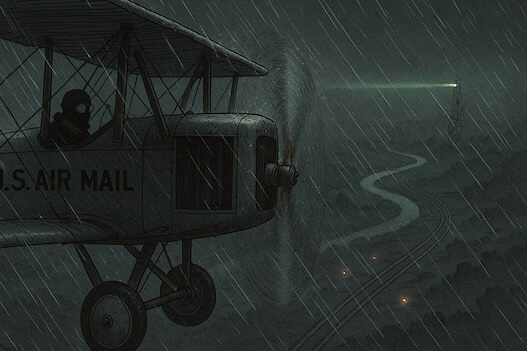
Night mail biplane (illustration)

Night Raiders of the American Sky

While jazz music filled the air and Americans danced on the ground, high above, a handful of daredevils flew airplanes through the night.

Newspapers dubbed them the "Suicide Club." They were the night U.S. Air Mail pilots. They sat in open cockpits, buffeted by wind, gripping the controls with frozen hands. No radio, and only basic cockpit instruments. Just a wood-and-fabric airplane — and an endless night ahead.

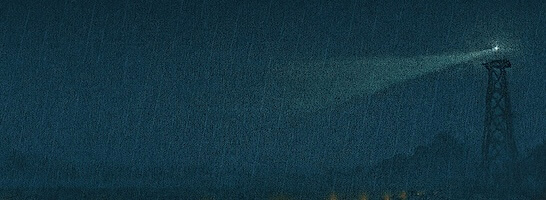
Stars were their compass, and a thin chain of airway beacons and railroad tracks led them home. Every flight became a duel with the elements. These pilots showed how night flying moved from daredevilry to a disciplined system—laying the groundwork for commercial aviation.

Mail airplane 1920

Why Fly at Night?

It was a dream. To cross America by airplane and deliver mail faster than trains. By 1920, this dream was almost reality. A daytime-only transcontinental route from New York to San Francisco was already operating.

But when the sun set, the dream ended. Mail bags were unloaded from planes and transferred to railroad cars. The mail then traveled on slow trains. Hours saved in the sky were lost on the rails...

Congress frowned at the numbers—what were we paying for, wings that couldn't fly at night?

The Air Mail Service faced a choice: fly around the clock or shut down. Night became the main enemy—and they set out to defeat it.

≈10 miles
The distance between airway beacon lights. A chain of lights created an unbroken corridor.
≈85–100 knots
Typical cruising speed of mail planes (≈98–115 mph). New York to Chicago — ~6–7 hours of flight time.
−4°F (−20°C)
Open cockpits meant pilots risked frostbite. They had to bundle up for protection.
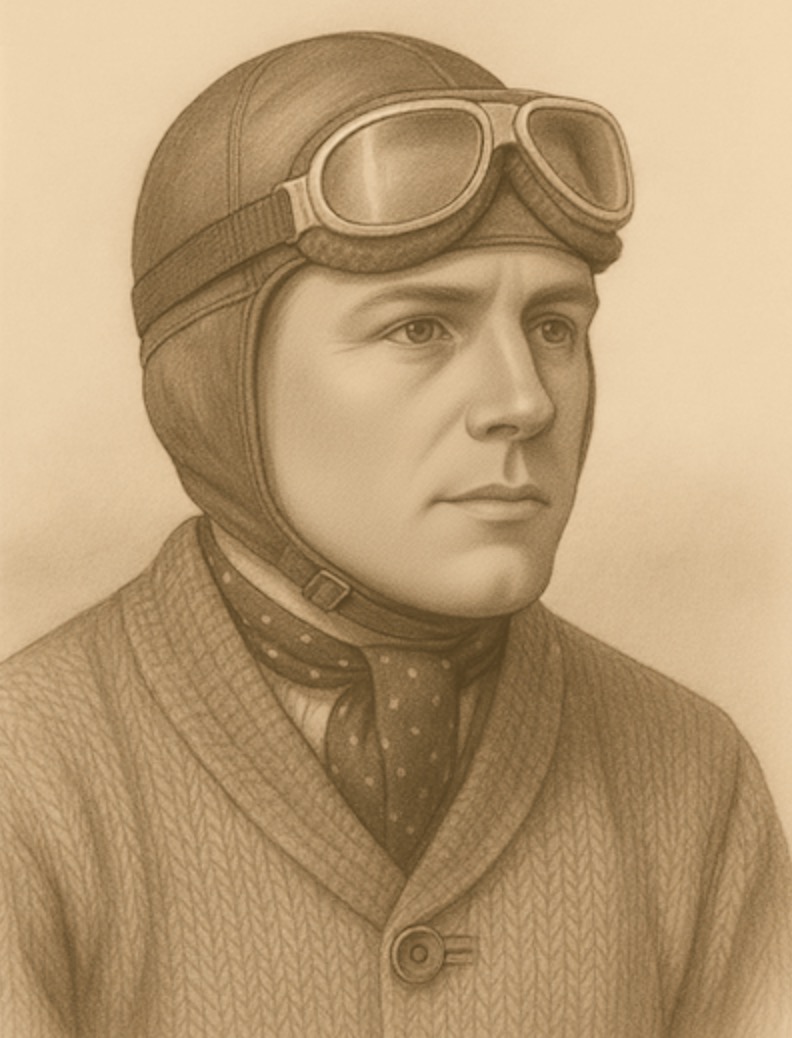
Night pilot in full gear, 1920s
Night Mail Pilot

Night Pilot Equipment

Leather helmet with chin strap

No radio headset — just basic protection from wind and cold.

Goggles with leather or felt padding

Wide strap over the helmet with a metal buckle — typical 1920s style.

Wool sweater or cardigan and silk scarf

Scarf ends tucked under sweater for safety reasons.

Thick leather gauntlet gloves

Pilots used silk liners under leather gauntlets; hot drinks in a vacuum bottle (Thermos) helped between flight legs.

"In an open cockpit at ~8,000 feet (≈2,440 m), temperatures could drop to -22°F (-30°C). Survival depended on proper gear."
— From night pilots' memoirs

Technology and Navigation

Sample airway: approximately every 3rd beacon is a FIELD (click on beacon for information)
1
BEACON
2
BEACON
3
FIELD
4
BEACON
5
BEACON
6
FIELD
7
BEACON
8
BEACON
9
FIELD
10
BEACON
11
BEACON
12
FIELD

Green course lights guided the airway; at FIELD sites they pointed to a prepared landing area.

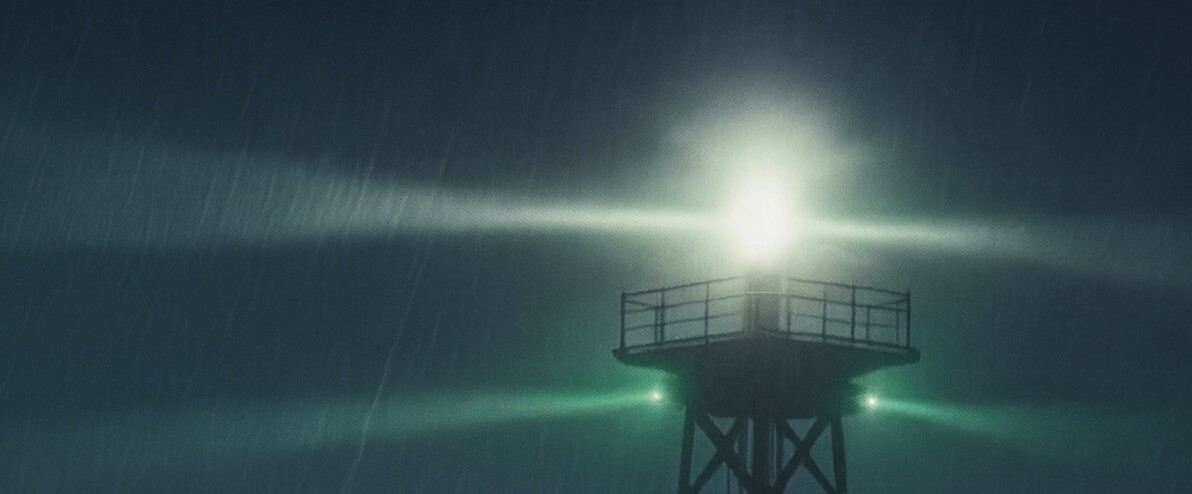
Beacon towers
Beacon Towers

Heartbeat of the Airway

In absolute darkness, each beacon became an island of life. It wasn't just a light — it was a sophisticated navigation machine designed to defeat the night.

The heart of the station was a rotating white airway beacon. The white beam swept the sky at about six flashes per minute and, in clear air, could be seen up to ~40 miles.

On the platform sat two green course lights. They indicated direction—forward and backward along the airway—and flashed the station’s identification letter in Morse.

Together these elements formed an integrated navigation system. And a caretaker kept the beacon operating through the night. While they were on duty, it meant the sky for desperate pilots would never go dark.

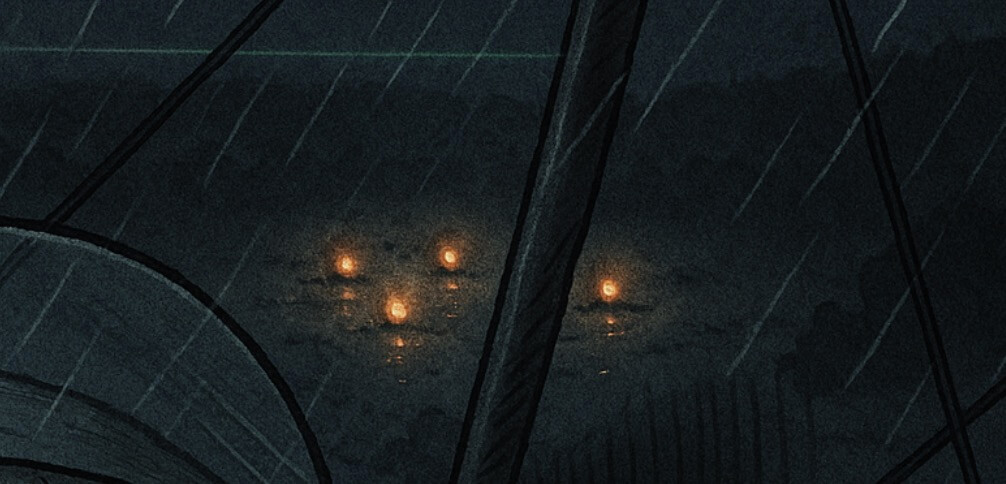
Emergency fields
Emergency Fields

Illuminated Islands of Salvation

In the night sky, every breakdown could become a disaster. Understanding this, airway engineers created a rescue network — a chain of emergency landing fields stretched along the route.

About every third beacon—roughly 30–50 miles apart—an emergency landing field awaited. The pilot knew: whatever happened to the aircraft, safe ground was always nearby — the main thing was knowing where to fly.

At dusk, the caretaker set out kerosene smudge pots to mark the strip. When an aircraft in distress appeared, portable floodlights or searchlights—where available—were used to illuminate the strip.

This saved many lives when engines failed or sudden weather struck.

Course light
Course light (green beam)

Safety Signal

Course lights spoke to pilots by color and code: two narrow green beams aligned with the airway and flashing an identification letter in Morse.

The beam color answered the most important question in the night sky: can I land here?

At FIELD sites the green beams were aimed to point to the emergency strip; elsewhere they simply pointed along the airway. (Course lights themselves were green; red lamps served obstruction and other warning roles.)

But that wasn't all. Each airway used a repeating ten-letter code—W-U-V-H-R-K-D-B-G-M—flashed in Morse by shutters on the course lights. The letters identified beacon numbers (1–0) along that airway, so pilots could read the dots and dashes and know precisely where they were on the airway map.

Mail biplane DH-4 in flight

Workhorses of the Night Sky

Light beacons pierced the darkness, brave pilots gripped the controls — but without the third hero of night Air Mail, everything else lost meaning. Wood-and-fabric biplanes with two-blade propellers—fragile creations of struts and fabric, but with a heart of steel. They punched through walls of rain, snow flurries, and headwind gusts.

In the early years of night flights, the backbone of the mail service was war veterans — converted DH-4s. Later they were joined by Douglas M-2 and M-3. Every night, man and machine challenged the elements — the mail absolutely had to reach its destination.

The Flight That Changed Everything

In early 1921, storm clouds gathered over the airmail service. Congress prepared to kill the program — too dangerous, too expensive. One chance remained: conduct a bold experiment. Deliver mail across the continent in a continuous relay, maintaining movement day and night.

On the night of February 22-23, 1921, the mail relay reached North Platte, Nebraska. Here, Jack Knight took the controls — he had to fly to Omaha. He made it, but landing in an ice storm was just the beginning of the nightmare. At the airfield, word came: the relief pilot in Omaha couldn't take off due to a blizzard. The relay faced failure. If mail got stuck here, the program would die. Forever.

And then Knight spoke the words that entered history: "I'll carry on.". One against the elements. Alone, with short refueling stops, he covered about 830 miles (~1,335 km) from North Platte to Chicago. In absolute darkness, at temperatures around 10°F (-12°C). Below, bonfires were lit for him — postal workers, field managers, and farmers. Newspapers nationwide followed the lone airplane across the night sky.

"I felt like I had a thousand friends on the ground" — James Herbert "Jack" Knight

This legendary flight changed the course of history. Persuaded by the demonstration, Congress funded night-flying infrastructure—airway beacons, course lights, and emergency fields. And Jack Knight became one of the most famous pilots of the pre-war postal service.

Highway in the Sky

Jack Knight's feat opened the door to the incredible — creating a Transcontinental Lighted Airway. This bold plan was to transform the hostile darkness of the night sky into an illuminated highway where airplanes went from light to light, like ships following sea routes.

On July 1, 1924, the first star of a new era lit up in the sky. Regular night service began between Chicago and Cheyenne — a chain of rotating beacons transformed the route into a scatter of guiding lights. But engineers went further. They created a true navigation symphony of light.

Course lights winked at pilots: here's an emergency field, here's your salvation in a difficult moment. Course lights flashed each station’s identification letter in Morse — a unique call sign for each. Looking down, a pilot immediately understood: there it is, point number five, or seven, or ten on the airway map.

From the mid-1920s, giant concrete arrows marked the route—huge pointers visible from altitude in daylight. By 1933, more than 1,500 beacons lit over 18,000 miles of airways across the United States. Day and night, in rain and snow, "airway keepers" watched over this giant light organism — dedicated caretakers.

Aircraft

The main night mail aircraft was the American-modified de Havilland DH-4B (“Mail Plane”) with a 12-cylinder Liberty L-12 (about 400 hp). Could carry up to 500 pounds (≈227 kg) of mail. Fuel capacity varied by variant: standard DH-4 — about 67 U.S. gallons (≈254 L); DH-4B “Mail Plane” — up to 110 U.S. gallons (≈416 L); some long-range fits — up to 135 U.S. gallons (≈511 L).
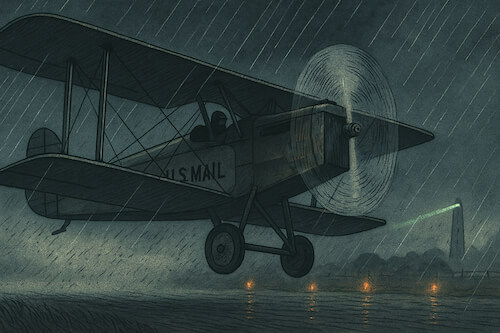
de Havilland DH-4 biplane, 1920s
DH-4B (U.S.), Liberty L-12, mail conversion

de Havilland DH-4B "Flaming Coffin"

⚡ Speed
Max. ≈128 mph (206 km/h)
🌏 Range
≈400 miles (640 km)
🔧 Construction
Wooden structure, fabric covering
💡 Night equipment
Luminous instrument dials; Very pistol with parachute flares; no built-in landing lights early in the decade (fields used smudge pots)

Why "Flaming Coffin"? The danger was related to the placement of the large fuel tank between the pilot and observer on American DH-4s with Liberty L-12 — in crashes this could lead to post-crash fires. In the DH-4B conversion, the pilot’s cockpit was moved aft, behind the tank, and some design risks were reduced, but the problem wasn't completely eliminated. Later, the Air Mail Service moved to specialized, safer mailplanes.

Pilots: A Special Breed

Night pilots formed an aviation aristocracy. Battle-hardened World War I veterans, fearless adventurers, obsessed enthusiasts — those who weren't afraid to challenge the darkness. For this risk, they were paid generously: about $3,600 a year plus 5–7 cents per mile. At the time, that was roughly two to three times the average salary.

The brightest star of this harsh school was young Charles Lindbergh. Beginning in April 1926, he flew the CAM-2 mail route between St. Louis and Chicago — a route that forgave no mistakes. More than once he had to bail out—making night parachute jumps into darkness. But these deadly lessons proved invaluable. Later, Lindbergh would say: it was these nights over America, full of danger and solitude, that forged the iron will that carried him across the Atlantic in his legendary solo flight of 1927.

The Price of Progress

Behind the romantic image of aviation pioneers hid cruel arithmetic: about 35 Air Mail pilots died in the first decade of service.

But their deaths weren't in vain. Each crash became a lesson, each loss — a step toward safety. Maps and weather reports improved, lighted airways and emergency fields appeared, instruments and aircraft were refined. In 1919 the fatality rate was shocking. By the mid-1920s it had improved severalfold. Lighted airways and stricter procedures gradually won the night—and saved lives.

The Great Legacy

By 1927, the government left flying the routes and transferred them to private contractors. Pilots and infrastructure seeded the private carriers that became United Air Lines and American Airways (later American Airlines).

They didn't just deliver letters. Through incredible effort—often at great personal risk—Air Mail pilots laid the foundations of modern aviation and proved that the night sky could be conquered.

Their legacy lives on in every modern night flight.
Pilot Quotes

"I learned that any danger is relative. Its true scale is seen only through the lens of experience"
Charles Lindbergh
"When the engine failed, I glided to a field, but a sudden downdraft dropped 40 feet of altitude. I couldn't clear the wires... but the mail had to be saved"
from Jack Knight’s report
"They flew in open cockpits, in any weather—what they called “cowboy spirit”: a determination to finish the job no matter what."
Contemporary description

Video

A short clip illustrating the work of night U.S. Air Mail pilots

Further Reading & Primary Sources (click to expand)